
What is a Pitch Raise? (And Why Can’t We Just Tune It?)
When a piano hasn’t been serviced in a long time, it is most often the case that the pitch has drifted away from the global standard: A440.
The ISO (International Organization for Standardization) states that the standard for musical pitch is A440. This means we aim for A above middle C on your piano to vibrate at 440 Hz (cycles per second). When the pitch is considerably lower than that, a standard tuning isn't enough. We need a pitch adjustment (or pitch raise).
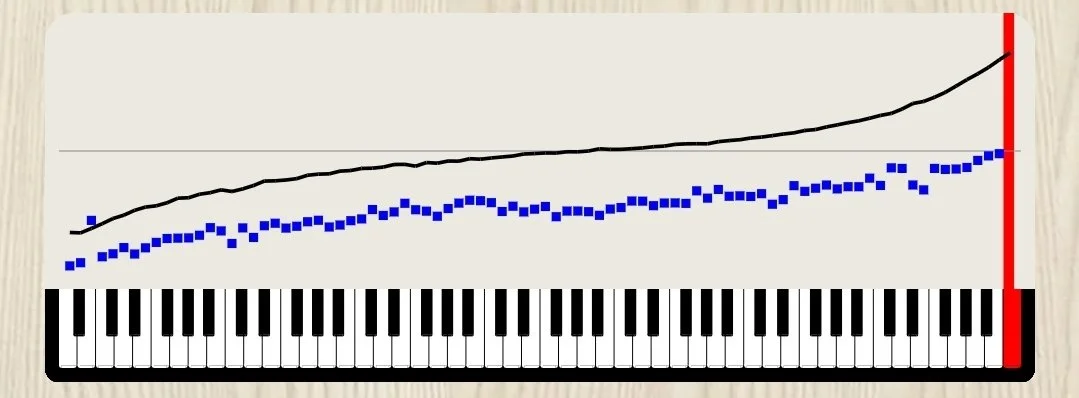
To put it simply: a piano is a living, breathing machine under immense pressure.
When a piano is a semitone flat, and I increase the pitch 100 cents to reach A440, I am essentially adding about two tons of pressure to the instrument. (While this is a simplification, it illustrates the sheer physical stress being reintroduced to the piano.)
Because the piano is a cohesive structure, you cannot change the tension in one section without affecting the rest. If I start on the bass strings and raise the pitch, the tension in the treble strings will decrease significantly before I even get to them. As I work on the treble, the tenor and bass sections begin to shift again.
The piano is constantly adjusting both while I work and after I leave.
Three Hurdles to Stability
Why does a pitch raise require multiple passes and follow-up visits? It comes down to how the physical components of the piano relax:
The Memory of the Wire: Piano strings wrap around pins and pass over bridges and bars. When I tighten a string, the part that used to be wrapped around the pin is now pulled straight. That section of wire needs time to "let go of its kink," stretch out, and relax into its new position.
The Balancing Act: As I increase tension in one area, the piano's wooden structure responds accordingly. This causes the tension of other strings to fluctuate; it is a moving target.
The Settling Period: A string doesn’t relax around the pin immediately; it happens over the following hours and days. This is why I tune the piano 2-3 times during the initial appointment and recommend a follow-up tuning in 3–6 months to address adjustments that only develop over time.
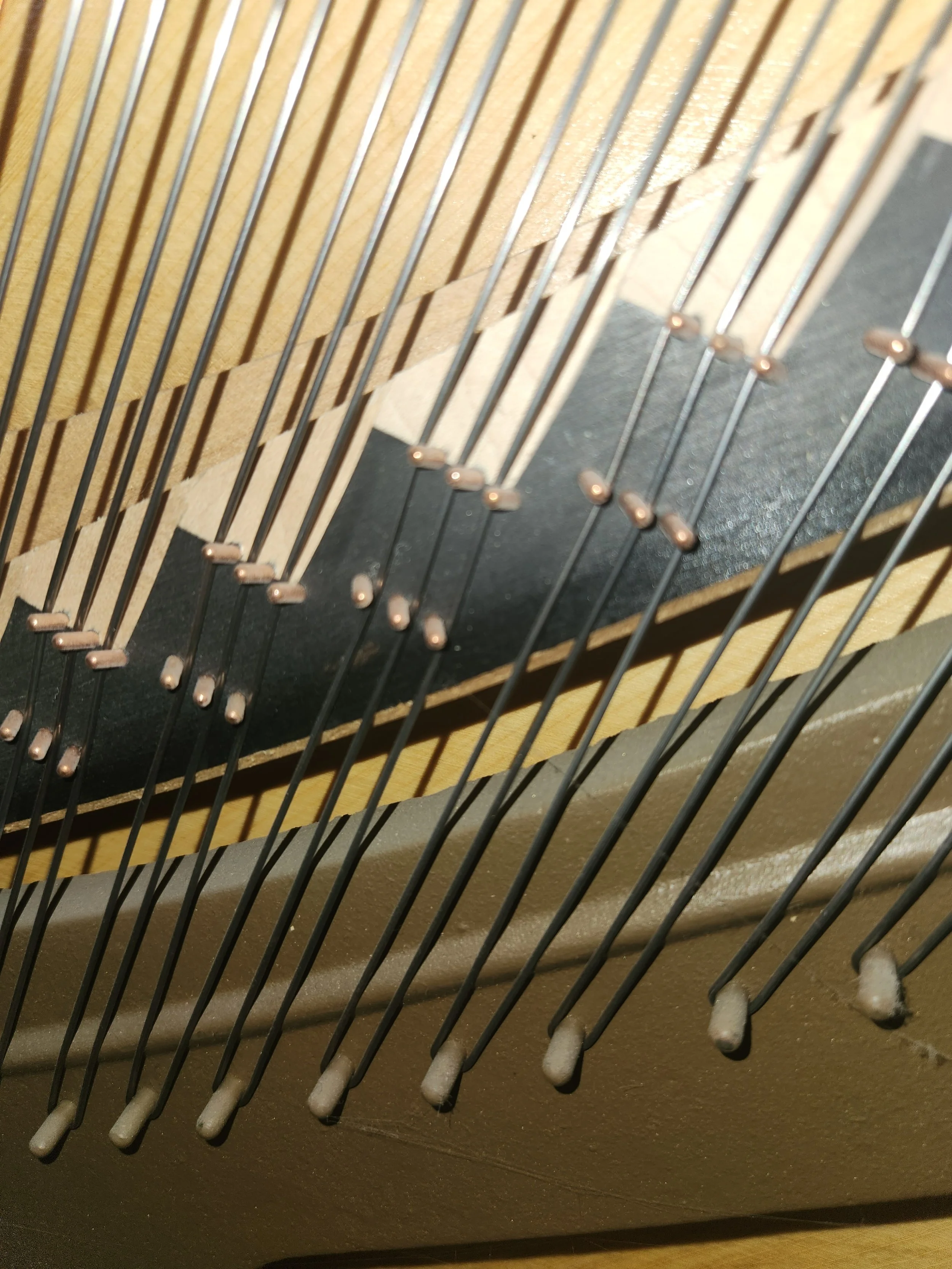
Piano strings wrapped around pins.
From Speed to Perfection
During a pitch raise, my initial focus is on speed and efficiency over perfection. Because there is no hope of the strings staying exactly where I leave them on the first pass, obsessive accuracy at the start is a waste of energy.
Depending on the situation, I may use a specialized tuning device to predict how much the pitch will drop. I might tighten a string 10–20 cents above the target, knowing it will fall into place by the end of the hour. As I move into the second and third passes, my focus shifts… gradually moving away from speed and toward a more refined level of accuracy.
Stability only comes through this repetition.
Understanding the Risks
There are risks that come with adjusting two tons of tension on a piano:
Broken Strings: This is a reality of piano maintenance. Strings break for many reasons, including age, imperfections in the metal, or flaws in scale design. While I use specific techniques to reduce this possibility, strings can (and do) break. They can also be replaced.
The Plate: In a worst-case scenario, the cast-iron plate can crack. These plates are built to handle the tension of A440, so a break can often indicate a factory imperfection in the casting. In hundreds of pitch raises, this has never happened to me, but it is a mechanical possibility.
The Bottom Line
A pitch raise isn't just a long tuning… It’s a structural reset.
If your piano has been neglected for years, it won't be stable after one hour. It needs at least two appointments (sometimes more) to stabilize at A440. If you’re worried your piano has dropped too far, the best time to start the recovery process is now.
The good news is that, even though it won't be perfectly stable after your first tuning, it will sound significantly better than it does when I first arrive!
